Your CISO already has the tools to satisfy APRA on AI
The question isn't what to buy. It's whether you're applying existing discipline to machines, not just people.
APRA’s letter is a warning not guidance
APRA’s April 2026 letter to regulated entities on artificial intelligence landed quietly. No new prudential standard. No consultation paper. Just a letter — signed by a Board Member — telling the sector it had conducted a deep-dive across major banks, insurers and superannuation trustees, and what it found wasn’t good enough.
That framing matters. APRA doesn’t write letters like this as friendly guidance. It writes them when it’s building a supervisory record.
I’ve spent a long time in the identity and access management space — building IAM programs for large Australian organisations, advising on governance frameworks, and more recently sitting in the CISO chair. When I read APRA’s observations, I didn’t see an AI problem. I saw a problem I’ve seen repeatedly across two decades, wearing a new coat.
What APRA actually found
APRA’s recent thematic reviews of AI adoption highlighted a glaring gap between the speed of deployment and the rigor of oversight. The regulator observed that while institutions are eager to reap the efficiency gains of Generative AI and advanced machine learning, their risk frameworks are lagging dangerously behind.
The core findings are unambiguous: boards lack visibility into where AI is deployed (Shadow AI), accountability models are fractured when an algorithm makes a decision, and institutions are failing to adequately monitor models for drift, bias, or data leakage over time. APRA is effectively declaring that the honeymoon phase of unregulated enterprise AI experimentation is over.
The insight that changes the conversation
In response to regulatory pressure, the reflexive enterprise instinct is procurement. But procuring isolated AI governance platforms often creates disjointed security silos. The practitioner’s reality is far more pragmatic: an AI agent is simply a highly privileged, dynamic service account.
If we strip away the anthropomorphic marketing language, AI models are non-human identities consuming data and executing actions. Your Chief Information Security Officer (CISO) already orchestrates the exact disciplines required to govern them. The challenge is not technological; it is cognitive. We must adapt our existing security frameworks to apply to machines with the same rigor we apply to humans.
IGA as the AI agent registry
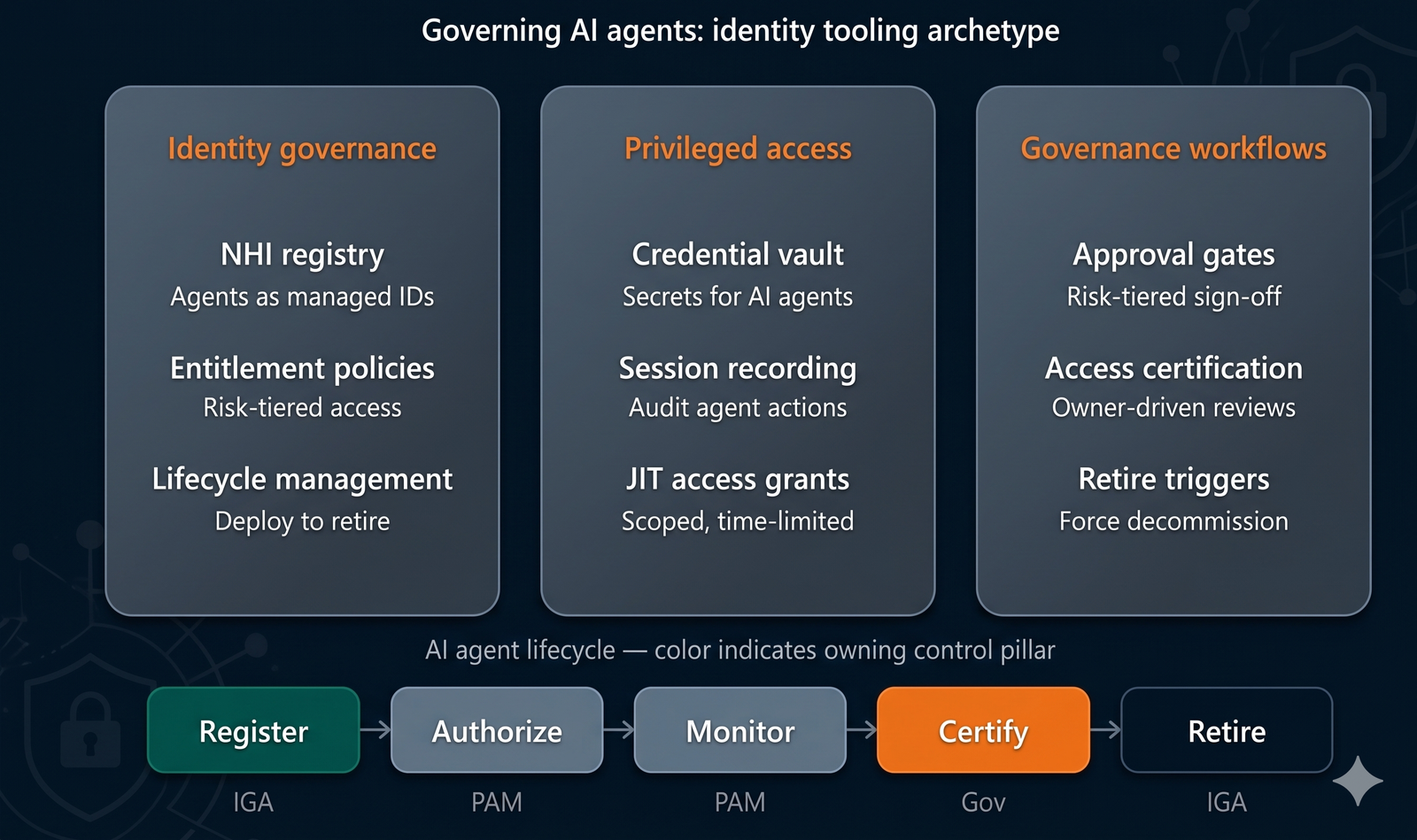
IGA is traditionally used to ensure Bob in Accounting only has access to financial systems. The exact same paradigm must apply to an LLM summarizing internal documents. AI models must be onboarded as identities into your IGA platform. They require strict Role-Based Access Control (RBAC), mandated recertification cycles, and definitive human owners. If an AI agent cannot clearly articulate who owns it and why it has access to a specific data repository, it fails the basic IGA sniff test.
PAM as the AI credential broker
AI models that can alter infrastructure, execute code, or make financial decisions are operating with privileged access. These actions cannot occur without oversight. PAM frameworks provide the solution: credential vaulting for API keys used by AI models, session recording (via prompt logging and telemetry capture), and just-in-time elevation. When an AI attempts a high-risk transaction, your PAM architecture should trigger a mandatory human-in-the-loop (HITL) approval step.
Governance workflows as the AI deployment gate
Your organization already has mechanisms for Third-Party Risk Management (TPRM) and application security testing. These GRC workflows simply need their taxonomy updated. “Application vulnerability scanning” becomes “Model red-teaming.” “Vendor risk assessment” becomes “Foundation model provenance review.” The pipelines, risk registers, and reporting dashboards that APRA expects already exist—they just need to ingest AI telemetry.
The harder question
Chasing shiny new AI governance platforms is a distraction from the real work. Your CISO already holds the keys to compliance. Identity, privilege, and audit are universal truths of security, whether the actor is a carbon-based employee or a silicon-based neural network.
The question isn’t what to buy. It’s whether you’re applying existing discipline to machines, not just people.